
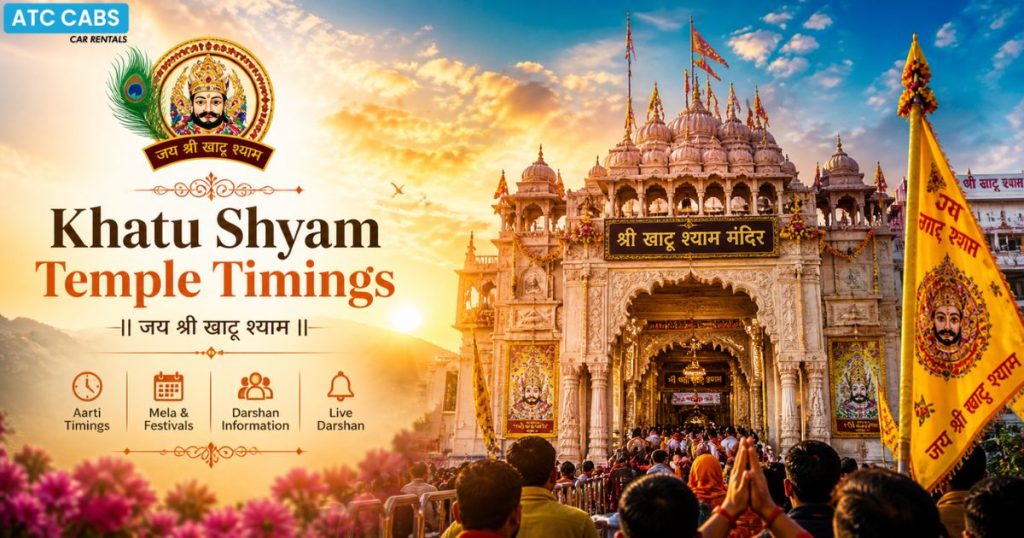

Every year, millions of devotees across India begin one of the most emotionally powerful journeys of their lives — a pilgrimage to Shri Khatu Shyam Ji Mandir in Rajasthan. Some come in anguish, some in gratitude, some simply because they feel called. And every single one leaves with something they cannot quite put into words.
But experienced pilgrims will tell you: how well you plan determines how deeply you experience it. Wrong timing means missing the Mangala Aarti. No preparation on a festival day means hours in a crowd of lakhs. This guide covers everything — darshan timings, aarti schedule, festival dates, VIP darshan, travel tips, and FAQs — so your visit to Khatu Dham is smooth, peaceful, and truly unforgettable.
The Legend of Khatu Shyam Ji: Why Millions Believe
Khatu Shyam Ji is worshipped as the Kaliyug avatar of Lord Krishna. His true identity is Barbarika — the supremely powerful grandson of Bhima from the Mahabharata, son of Ghatotkacha. He possessed a divine bow and three infallible arrows gifted by Lord Shiva, capable of ending any battle in moments.
When Lord Krishna (in disguise) asked Barbarika whose side he would fight on in the Kurukshetra war, Barbarika said he would always fight for the weaker side — a noble vow that would have paradoxically destroyed everyone by switching sides endlessly. Krishna then asked for Barbarika’s head as a donation. Without hesitation, Barbarika offered it. Deeply moved, Krishna blessed him: in the age of Kali, he would be worshipped as Shyam and known as Khatu Naresh — the King of Khatu.
His divine head was later discovered buried in the earth at Khatu village — found when a cow was seen spontaneously releasing milk onto one particular spot daily. A temple was built there. That idol is what millions travel hundreds of kilometres to see — not a stone replica, but according to faith, the actual head of Barbarika.
“Haar ke jeetne wale ko Babaji Shyam kehte hain” (One who wins even after losing — that is Shyam Baba)
Baba is the lord of the helpless. He does not distinguish between rich and poor. Come with sincerity — and he hears you.
About Khatu Shyam Mandir: Location, Architecture & Premises
Official Name: Shri Shyam Mandir Managed By: Shri Shyam Mandir Committee, Khatu Dham Location: Khatu Village, Sikar District, Rajasthan — PIN 332602
The temple is built entirely of white marble with intricate artistic carvings and traditional Rajasthani temple architecture. The inner sanctum (garbhagriha) houses the sacred idol of Shyam Baba — a dark-complexioned stone idol adorned daily with royal garments, flower garlands, gold jewellery, and an elaborate crown.
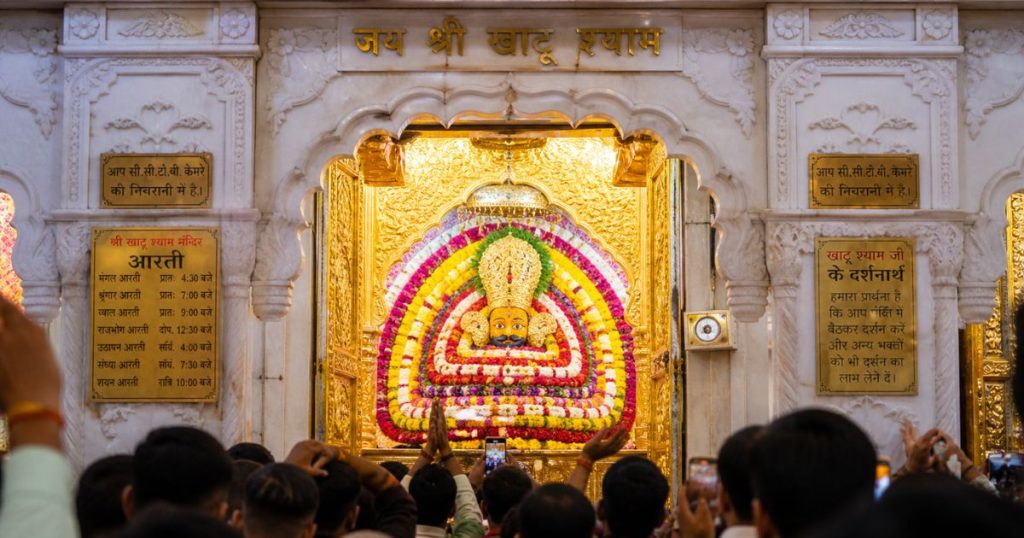
The full Khatu Dham complex includes:
Shyam Kund — A sacred pond located adjacent to the temple. This is where the head of Barbarika is said to have been discovered, and the water is considered holy and healing. Devotees traditionally take a ritual bath here before proceeding to the temple for darshan. Many believe the water has medicinal properties.
Shyam Bagicha — A serene garden within the temple complex, ideal for quiet meditation and reflection before or after darshan.
Nishan Yatra Path — During the Phalgun Mela, devotees undertake the Nishan Yatra, walking barefoot from distant places carrying triangular holy flags (Nishans) as offerings to Shyam Baba. The path leading into Khatu village fills with these flag-bearers during the Mela season.
Temple Market (Mandir Road) — A lively street leading to the temple, lined with shops selling marigold garlands, sindoor, religious items, Rajasthani sweets, masalas, traditional clothes, silver jewellery, and devotional music.
Interesting fact: The temple premises is said to have 13 stairs leading up to the main sanctum. Many devotees believe these stairs hold a mystical significance, and counting them carefully is a part of the darshan ritual for some.
Khatu Shyam Temple Timings: Complete Season-Wise Schedule
The Khatu Shyam Mandir follows a seasonal darshan schedule — opening and closing at different times in summer and winter. This is primarily to manage the enormous daily footfall while maintaining the sanctity and rhythm of temple rituals.
Important Disclaimer: Timings listed here are based on the most current verified sources as of May 2026. Temple timings can change during major festivals, extreme weather, or administrative decisions.
Khatu Shyam Temple Daily Darshan Timings — Summer & Winter
| Darshan Session | Summer (April – September) | Winter (October – March) |
| Temple Opens (Morning) | 4:30 AM | 5:30 AM |
| Morning Darshan Ends | 12:30 PM | 1:00 PM |
| Afternoon Closure | 12:30 PM – 4:00 PM | 1:00 PM – 5:00 PM |
| Evening Darshan Opens | 4:00 PM | 5:00 PM |
| Temple Closes (Evening) | 10:00 PM | 9:00 PM |
| On Ekadashi | Open 24 Hours | Open 24 Hours |
| During Phalgun Mela | — | Open 24 Hours (10 Days) |
Why does the temple close in the afternoon?
The afternoon closure (roughly 12:30 PM to 4:00–5:00 PM) is observed for the deity’s “rest time” — consistent with traditional temple practice across India. This period is used by the priests for internal rituals, offering the midday bhog (food), and temple maintenance. Devotees cannot enter during this window.
Pro Tip from ATC Cabs: If you are travelling from a city like Agra or Delhi, plan your departure time so that you arrive at the temple by 5:00 AM to 6:00 AM. This gives you time to take a dip at Shyam Kund, freshen up, and be in the darshan queue before the main morning crowd builds. By 9:00–10:00 AM on weekdays, queues can already be quite long.
Khatu Shyam Ji Aarti Timings: The Complete Daily Schedule
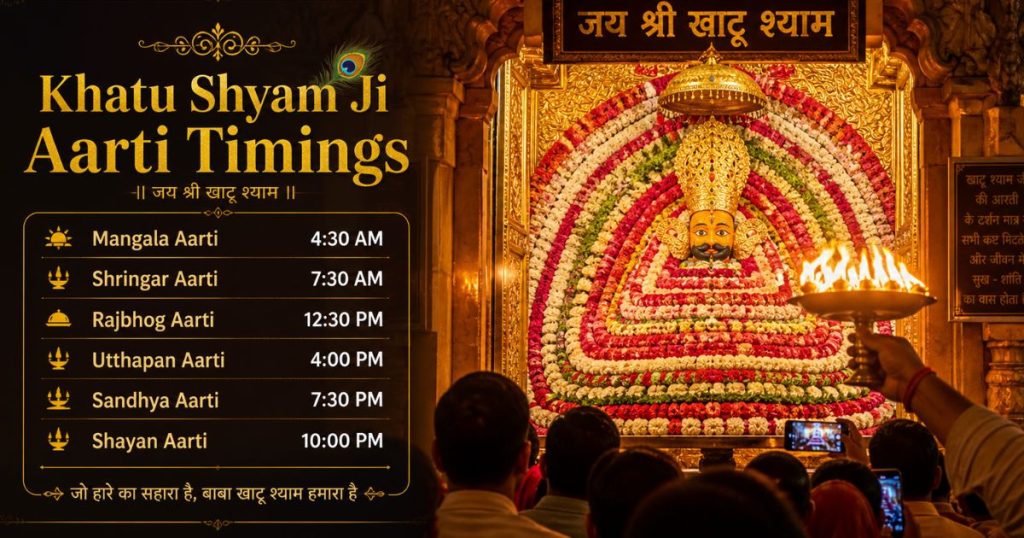
The five daily aartis at Khatu Shyam Mandir are the heartbeat of the temple’s spiritual rhythm. Each aarti marks a distinct moment in the deity’s divine day — from waking and adorning, to offering food, evening prayer, and finally rest. Attending even one aarti can transform your entire visit from a routine darshan into a genuine spiritual experience.
Khatu Shyam Aarti Timings — Summer & Winter
| Aarti Name | Summer Timing | Winter Timing | What Happens |
| Mangala Aarti | 4:30 AM | 5:30 AM | The deity is awakened; first light of devotion for the day |
| Shringar Aarti | 7:00 AM | 8:00 AM | Baba is adorned with flowers, jewels & fresh clothes |
| Bhog Aarti | 12:00 PM | 12:30 PM | Food is offered; midday prayers performed |
| Sandhya Aarti | 7:30 PM | 6:30 PM | Evening prayers; temple lit with lamps |
| Shayan Aarti | 10:00 PM | 9:00 PM | Baba is put to rest; the last ritual of the day |
Which Aarti Should You Prioritise?
Mangala Aarti is universally considered the most spiritually powerful aarti of the day. The pre-dawn atmosphere inside the temple — the softly lit sanctum, the bell sounds echoing in the stillness, the first glimpse of the deity’s adorned face — is an experience devotees describe as life-changing. Arrive 15–20 minutes early to find a good position.
Shringar Aarti is deeply moving in a different way. Watching the priests carefully dress, adorn, and decorate Shyam Baba’s idol with elaborate flower arrangements and gold jewellery feels like witnessing something sacred and intimate.
Sandhya Aarti is the most visually spectacular. The temple is illuminated, the crowd sings devotional bhajans in full voice, and the energy is electrifying. If early mornings are difficult for you, this is the aarti not to miss.
Shayan Aarti is quiet and deeply peaceful. Attending it feels like saying a personal goodnight to the deity — intimate, reflective, and emotionally moving.
Chappan Bhog: The Divine Feast of 56 Offerings
One of the unique and lesser-known aspects of Khatu Shyam Mandir that competitors rarely cover is the Chappan Bhog — the offering of 56 different food items to Shyam Baba.
This tradition, rooted in Vaishnavism, involves the daily preparation and offering of an elaborate menu of sweets, savouries, fruits, and food items to the deity. The number 56 is symbolically significant — it is said that Lord Krishna, during his childhood in Gokul, consumed 56 food items a day to sustain his divine energy during a period when he lifted Govardhan mountain for seven days.
The prasad (blessed food) distributed to devotees at Khatu Shyam has a special significance for the faithful. Many regular devotees say the prasad here tastes distinctly different — sweeter, more fragrant — from anything you find outside. Whether or not one subscribes to this, accepting the prasad with both hands and receiving it as Baba’s blessing is a moment of genuine grace for pilgrims.
Extended Darshan: Special Days & Festival Timings
Ekadashi — The Most Important Day at Khatu Shyam
Ekadashi (the 11th day of both the waxing and waning lunar cycles) is the most regularly celebrated special day at Khatu Shyam Mandir. Shukla Paksha Ekadashi (11th day of the waxing moon fortnight) in particular attracts the heaviest crowds.
On every Ekadashi, the temple remains open for 24 consecutive hours without any afternoon closure. Devotees arrive from the night before, some walking barefoot for miles as a mark of devotion. Queues can extend for several hours during peak Ekadashi days.
Practical advice for Ekadashi visits:
- Arrive by 3:00–3:30 AM to be near the front of the Mangala Aarti queue
- Carry your own water and light snacks — food stalls may have long queues too
- Book accommodation well in advance (at least 2–3 weeks ahead for popular Ekadashis)
- Travel light — bags and large luggage are not permitted inside the sanctum
Phalgun Mela (Falgun Lakhi Mela) — The Grand Annual Festival
This is the single most spectacular event at Khatu Shyam Mandir and arguably one of the most extraordinary religious gatherings in all of Rajasthan.
Phalgun Mela falls during the Hindu month of Phalgun (typically February–March), in the days leading up to Holi. The Mela runs for 10 consecutive days, during which the temple remains open 24 hours a day without interruption.
What makes Phalgun Mela truly extraordinary is the Nishan Yatra — groups of devotees walk barefoot from their home towns and villages, sometimes covering hundreds of kilometres over several days, carrying tall triangular orange flags (Nishans) as an offering to Shyam Baba. The sight of these Nishan processions entering Khatu village — thousands of bare feet, the sound of devotional chanting, the flutter of orange flags — is one of the most powerful sights in Indian religious culture.
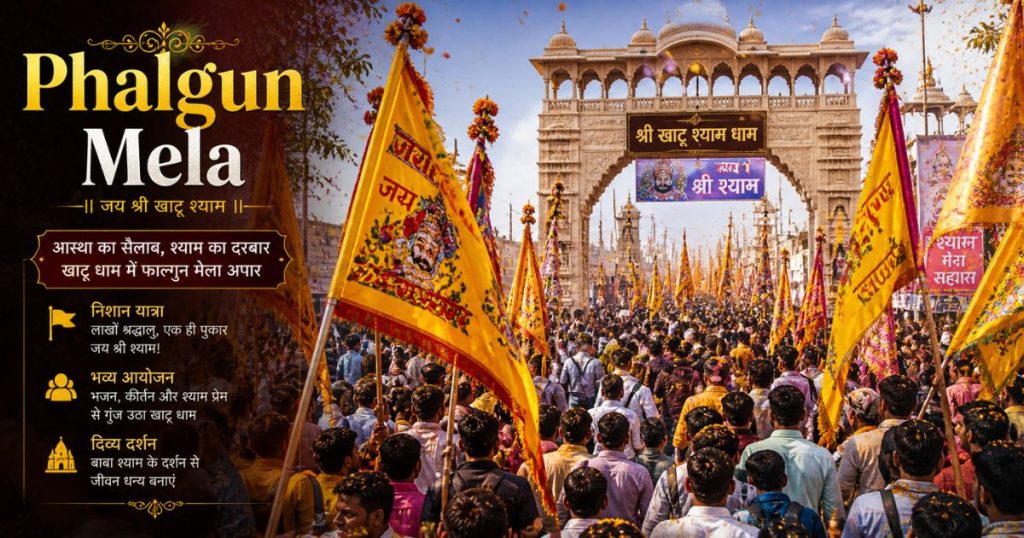
During the Mela, on the 12th day (Dwadashi), a special bhog of Kheer and Churma is offered to Shyam Baba. The entire village is transformed — roads are lined with food stalls, accommodation fills to capacity, and the air is thick with incense, music, and devotion.
If you have never experienced Phalgun Mela, put it on your spiritual bucket list. But plan far in advance — accommodation within 50 km of Khatu gets fully booked weeks ahead.
Festival Calendar & Special Darshan Days at Khatu Shyam
| Festival / Special Day | When It Occurs | Temple Hours | Special Features |
| Ekadashi (Shukla Paksha) | Every lunar fortnight (monthly) | 24 Hours | Heaviest footfall; extended darshan |
| Poornima (Full Moon) | Monthly | Extended hours | Special prayers and bhajans |
| Phalgun Mela (Falgun Lakhi Mela) | Feb–March (before Holi) | 24 Hours / 10 Days | Nishan Yatra, Kheer-Churma bhog |
| Janmashtami | August (Lord Krishna’s birthday) | Extended till midnight | Elaborate decoration, special aarti |
| Diwali | October–November | Extended till midnight | Lamps, fireworks, special pooja |
| Navratri | March–April & Sept–Oct | Extended hours | Special bhajans, nine-day celebrations |
| Holi | March | Extended hours | Closely linked with Phalgun Mela |
| Shyam Baba’s Birthday (Kartik Sud Ekadashi) | October–November | 24 Hours | Most significant personal celebration |
VIP Darshan at Khatu Shyam Temple: Skip the Queues
For devotees who are elderly, travelling with young children, or have limited time, the Shri Shyam Mandir Committee offers VIP Darshan and Special Darshan Passes that allow priority queue access, significantly reducing waiting time.
General darshan remains completely free. No ticket, registration, or booking is required for standard darshan. VIP passes are an optional convenience for those who want faster access.
Khatu Shyam VIP Darshan Pass Types
| Pass Type | What It Offers | How to Book | Best For |
| General Darshan | Standard queue, free entry | No booking needed | All devotees |
| VIP Darshan Pass | Priority queue, faster access | Online via shrishyammandir.com | Families, elderly, first-timers |
| Tatkal Pass | Last-minute priority access | Temple counter (limited) | Unplanned visits |
| Special Entry Pass | Dedicated entry, minimal waiting | Online advance booking | Groups, special vows/occasions |
Temple Rules & Etiquette: What Every Devotee Must Know
Knowing and following temple rules is a mark of respect — and practically speaking, it prevents you from being turned away at the gate.
Dress Code: Modest, traditional clothing is mandatory. Wear a dhoti-kurta, salwar-kameez, saree, or any clean traditional attire. Women should carry a dupatta or stole to cover their head inside the sanctum. Shorts, sleeveless tops, ripped jeans, and revealing clothing are not permitted and will result in entry being denied.
Footwear: All footwear must be removed at designated areas before entering the temple premises. Footwear storage facilities are available nearby (a nominal fee may apply).
Mobile Phones, Cameras & Bags: Mobile phones, cameras, and bags are generally not permitted inside the main sanctum (garbhagriha). This is strictly enforced. Cloak rooms and storage counters are available near the temple entrance. Carry only essentials (ID proof, VIP pass if applicable, small wallet) into the sanctum.
Photography: Photography is permitted in the outer premises and open areas of the temple complex. It is strictly restricted inside the sanctum. Follow signage and instructions from temple security at all times.
Behaviour Inside the Sanctum:
- Maintain silence and composure inside the inner sanctum
- Avoid pushing or rushing during darshan — temple volunteers (sevadars) manage the queue
- Accept prasad with both hands; never waste it
- Do not touch the idol or the barrier around it
- Move briskly during darshan if the crowd is heavy — you will have time to pray while in the queue
Shyam Kund Bathing: If you plan to take a ritual dip in Shyam Kund, carry a full change of clothes. Exercise caution, especially with elderly family members or young children. The area can be slippery.
What to Pack for Your Khatu Shyam Pilgrimage
This is something almost no competitor guide covers — but experienced pilgrims know it matters enormously.
Essential Items to Carry:
- Government-issued photo ID (Aadhaar, PAN, Passport) — required for VIP darshan and accommodation check-in
- A change of clothes (for after Shyam Kund dip)
- Small coin purse or cash wallet (cards may not be accepted at all small stalls)
- Reusable water bottle — especially critical in summer months
- Light snacks for the journey — food at Khatu is available but stalls can be very crowded on busy days
- Comfortable flat footwear (you will walk a fair distance and remove shoes often)
- A dupatta or stole (mandatory for women in the sanctum; useful for men too in cold winters)
- Basic medicines: antacid, paracetamol, ORS sachets — long journeys in heat can cause fatigue
- Printed/downloaded e-pass if you have booked VIP darshan
- Printed accommodation confirmation if staying overnight
What NOT to Carry Inside the Temple:
- Bags, backpacks, or handbags
- Mobile phones, cameras
- Leather items (some traditional devotees avoid leather inside any temple)
- Food or drinks
How to Reach Khatu Shyam Temple: Complete Travel Guide
Khatu village is accessible by road, rail, and air. Here is a detailed breakdown for pilgrims travelling from different cities.
Distance & Travel Time to Khatu Shyam Temple from Key Cities
| Departure City | Distance (Approx.) | Travel Time (By Road) | Best Route |
| Jaipur | 80–90 km | 2–3 hours | NH-11 via Chomu/Sikar |
| Delhi / NCR | 283 km | 5–6 hours | NH-48 → NH-58 via Kotputli |
| Agra | ~370–380 km | 7–8 hours | Agra → Jaipur → Khatu |
| Sikar | 43 km | 1–1.5 hours | Direct road via Ringas |
| Ringas | 17 km | 30–40 minutes | Local road directly to Khatu |
| Udaipur | 431 km | 7–8 hours | NH-48 via Ajmer |
| Ahmedabad | 693 km | 11–12 hours | NH-48 |
| Bikaner | 220 km | 4–5 hours | NH-11 |
By Air : The nearest airport is Jaipur International Airport (JAI), approximately 80–90 km from Khatu village. From Jaipur airport, hire a cab (recommended) or take a bus to reach the temple. ATC Cabs offers reliable airport pickup and drop services with advance booking.
By Rail : The closest railway station is Ringas Junction (RGS), just 17 km from Khatu. Regular trains connect Ringas to Delhi, Jaipur, Bikaner, and other major cities. From Ringas station, local taxis, auto-rickshaws, and shared jeeps run frequently to Khatu village.
You can also arrive at Sikar Railway Station (43 km) or Jaipur Railway Station (80–90 km) and hire a cab from there. The roads from both are well-maintained.
By Road (Recommended): Road travel is by far the most popular and flexible way to reach Khatu Shyam, especially for families and groups. The highways connecting Jaipur, Sikar, and Khatu are in good condition and offer beautiful Rajasthani countryside views.
Planning Your Journey from Agra or Jaipur? ATC Cabs Is Ready
For pilgrims travelling from Agra, Jaipur, Mathura, or anywhere across North India, having a reliable, comfortable cab is not a luxury — it is peace of mind. A pilgrimage is an emotionally significant journey. The last thing you want is driver trouble, hidden charges, or a breakdown on the highway.
ATC Cabs has been the trusted travel partner for thousands of pilgrims visiting Khatu Shyam, Vrindavan, Mathura, Pushkar, and other sacred sites across North India. Our drivers are experienced, courteous, and familiar with pilgrimage routes. Our vehicles are clean, well-maintained, and GPS-tracked.
If you are starting your journey from Agra, our guide on Agra to Jaipur Cab Fare 2026 covers all pricing details, cab types, and travel tips for this route — from where you can continue comfortably to Khatu Shyam via Sikar. No hidden charges. No surprises. Just a smooth, safe ride.
Accommodation Near Khatu Shyam Temple
For devotees wishing to attend multiple aartis, participate in the Phalgun Mela, or simply soak in the divine atmosphere of Khatu Dham, staying overnight is the right choice.
Dharamshalas (Community Rest Houses): Several well-known dharamshalas are located within walking distance of the temple, offering basic but clean accommodation at minimal or no cost. Notable options include:
- Shree Shyam Prachar Mandal Dharamshala
- Karnavati Bhawan Dharamshala
- Sawariya Dharamshala
- Basesar Bhawan
- Surat Bhawan
- Vishram Bhavan
- Shree Shyam Sarkar Charitable Trust
These dharamshalas fill up extremely fast during Ekadashi and Phalgun Mela. Book weeks in advance if visiting during these periods.
Guest Houses & Budget Hotels in Khatu: A number of private guest houses have opened in and around Khatu village, catering specifically to pilgrims. They offer slightly more comfort than dharamshalas, with attached bathrooms and basic amenities.
Hotels in Sikar (43 km): Sikar offers a wider range of mid-range hotels with better facilities. Many devotees stay here and drive to Khatu for the morning aarti, returning after the evening aarti.
Hotels in Jaipur (80–90 km): For those who prefer full comfort and a wide range of hotel options — from budget to luxury — Jaipur is a viable base. Many devotees combine a Jaipur trip with a Khatu Shyam pilgrimage as a 2–3 day journey.
Best Time to Visit Khatu Shyam Temple: Month-by-Month Breakdown
November to February (Peak Season — Highly Recommended): This is the absolute best window. The weather is cool and extremely pleasant by Rajasthan standards (10°C to 22°C). Walking, waiting in queues, and exploring the premises are all far more comfortable. This period also includes Diwali, Kartik Sud Ekadashi (Shyam Baba’s birthday), and approaches the Phalgun Mela season. Book accommodation early.
March (Phalgun Mela Season): Extraordinary for the experience of Phalgun Mela but intensely crowded. Not suitable for those who find large crowds difficult. If you go, prepare for a once-in-a-lifetime spectacle of devotion.
April to June (Summer — With Caution): Temperatures in Rajasthan during these months can exceed 40–45°C. The temple opens at 4:30 AM in summer precisely to allow early morning darshan before the heat becomes intense. If visiting in summer, plan to be at the temple by 5:00 AM and complete darshan by 9:00 AM. Carry sufficient water.
July to September (Monsoon): The heat breaks, but humidity rises. Rain can occasionally disrupt road travel. The temple remains fully operational, and this is actually a moderately good time to visit if you want thinner crowds (many pilgrims avoid monsoon travel). The landscape around Khatu turns green and beautiful.
Best Days of the Week: Tuesday and Thursday are considered the most auspicious days for Shyam Baba and attract a steady, moderate crowd of regular devotees — more manageable than weekends. Avoid Saturday and Sunday for a calmer experience.
Things to Do in and Around Khatu Dham
Inside Khatu Dham:
- Attend the Mangala Aarti at the crack of dawn — the most serene experience the temple offers
- Take a ritual bath at Shyam Kund before darshan
- Offer a flower garland and pray at the idol
- Participate in the bhajan sessions that run continuously during festival periods
- Count the 13 sacred stairs leading to the main sanctum — a small ritual many devotees observe
- Explore the Shyam Bagicha garden for quiet reflection
Shopping in Khatu Market: The market street is vibrant with stalls selling marigold and rose garlands for offering, sindoor, prasad packets, devotional CDs and books, Rajasthani masalas, traditional sweets (try the local ghewar, malpua, and churma), silver jewellery, and handmade decorative items. Bargaining is common and expected.
Nearby Pilgrimage Sites:
- Salasar Balaji Temple (~57 km) — A highly revered Hanuman temple in the Churu district; many devotees combine Khatu Shyam and Salasar in one trip
- Jeen Mata Temple (~80 km) — An ancient goddess temple near Sikar with significant devotional following
- Sikar City (43 km) — Known for its beautiful havelis and as a historical Shekhawati region town worth exploring
Travelling from Mathura Region? ATC Cabs Connects You
Many devotees from Mathura, Vrindavan, Kosi Kalan, and the broader Braj region undertake extended pilgrimage circuits that combine the holy Braj dham with Rajasthan’s sacred sites. Khatu Shyam is a natural complement to a Braj pilgrimage — both are deeply connected to the Krishna devotional tradition.
If you are based in or travelling through the Mathura-Kosi Kalan belt and need a trustworthy cab service to connect these pilgrimage destinations, do explore our Reliable Kosi Kalan & Mathura Cab Services. ATC Cabs provides dependable, punctual, and fairly priced cab services connecting these holy towns to Jaipur, Khatu Shyam, and other sacred destinations across North India — with drivers who understand pilgrimage schedules and the value of being on time for an aarti.
Insider Tips: What Experienced Pilgrims Know
After years of helping pilgrims travel to Khatu Shyam, here are the practical insights our ATC Cabs drivers and regulars have shared:
1. The queue on the left side of the mandir road is often faster on regular weekdays. Experienced devotees know certain entry lanes move quicker than others. Observe and choose wisely on arrival.
2. If you miss Mangala Aarti, go directly for Shringar Aarti. The gap between the two is short, and the Shringar Aarti is equally powerful.
3. Prasad at Khatu Shyam is distributed generously. You do not need to purchase anything outside — simply wait for the prasad distribution inside.
4. The best photographs of the temple exterior are taken from the lane opposite the main gate around 5:30–6:00 AM, when the sunrise light hits the white marble and the crowds are still thin.
5. If you are visiting on an Ekadashi, park your vehicle at least 1–2 km away from the main gate. The approach roads fill with vehicles and devotees, making the last stretch best done on foot.
6. Carry a light rain jacket even in summer if visiting in July–September. Rajasthan’s monsoon rains come suddenly and can be heavy.
7. The temple has a “fast track” lane for senior citizens and physically challenged devotees even without a VIP pass. Ask at the temple entry gate for assistance.
8. Mobile phone network can be patchy inside the temple complex during peak days due to crowd density. Download your e-pass offline before arriving.
Conclusion
Khatu Shyam Ji Mandir is not simply a temple — it is a living testament to faith, sacrifice, and the extraordinary power of sincere devotion. Shyam Baba’s story is one of the most moving in all of Hindu mythology, and the temple that honours his memory is one of the most visited sacred sites in India for very good reason. When you stand before the idol of Khatu Shyam Ji — even for just a few seconds of darshan — most devotees feel something that is genuinely difficult to put into words.
With this complete guide to Khatu Shyam Temple timings, you now have everything you need to plan a pilgrimage that is not rushed, not stressful, and not filled with the logistical headaches that spoil so many temple visits. You know the right season, the best days, the aarti schedules, the special festival dates, the VIP darshan booking process, the temple rules, and how to get there comfortably.
Whether you are travelling from Agra, Jaipur, Mathura, Delhi, or any other corner of North India — book a comfortable, reliable cab with ATC Cabs and begin your journey to Khatu Dham the right way.
Jai Shri Shyam! 🙏
Frequently Asked Questions
Q1. What are the opening and closing timings of Khatu Shyam Temple?
In summer (April–September): Morning darshan is from 4:30 AM to 12:30 PM, and evening darshan is from 4:00 PM to 10:00 PM. In winter (October–March): Morning darshan is from 5:30 AM to 1:00 PM, and evening darshan is from 5:00 PM to 9:00 PM. The temple has an afternoon closure period for internal rituals.
Q2. Is Khatu Shyam Temple open 24 hours on Ekadashi?
Yes. On every Ekadashi (particularly Shukla Paksha Ekadashi), the temple remains open 24 hours continuously without any afternoon break. The same applies during the 10-day Phalgun Mela period.
Q3. What is the Mangala Aarti time at Khatu Shyam Mandir?
Mangala Aarti — the first aarti of the day — is performed at 4:30 AM in summer and 5:30 AM in winter. Arrive 15–20 minutes early to secure a good spot near the sanctum.
Q4. Is there an entry fee for darshan at Khatu Shyam Temple?
No. General darshan is completely free of charge for all devotees. No ticket or registration is required. VIP and Special Darshan Passes are available for a fee for those who want to avoid long queues.
Q5. What is the nearest railway station to Khatu Shyam Temple?
Ringas Junction (RGS) is the nearest railway station, located 17 km from the temple. From Ringas, local taxis, auto-rickshaws, and jeeps run regularly to Khatu village.
Q6. How far is Khatu Shyam Temple from Jaipur?
Approximately 80–90 km. The drive takes 2–3 hours by road via NH-11, making it a comfortable day trip from Jaipur.
Q7. How can I book a cab from Agra, Jaipur, or Mathura to Khatu Shyam Temple?
ATC Cabs offers reliable, transparent-priced cab services from Agra, Jaipur, Mathura, and other cities to Khatu Shyam Mandir and back. Visit www.atccab.com or check our detailed guides:Agra to Jaipur Cab Fare 2026 andReliable Kosi Kalan & Mathura Cab Services for full pricing and cab options.