
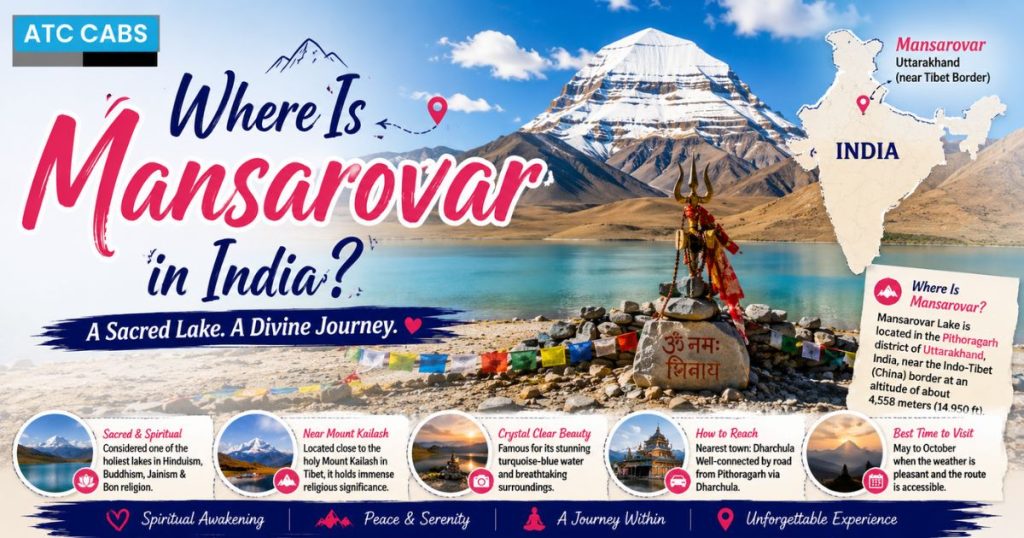

Quick Summary
- Mansarovar Lake is NOT located in India. It lies in the Tibet Autonomous Region of China, near Mount Kailash in Ngari Prefecture.
- It sits at an altitude of 4,590 metres (15,060 feet), making it one of the highest freshwater lakes in the world.
- The lake holds immense religious significance for Hindus, Buddhists, Jains, and followers of the Bon religion.
- Indians can visit via the Kailash Mansarovar Yatra — organised by India’s Ministry of External Affairs through two official routes: Lipulekh Pass (Uttarakhand) and Nathu La Pass (Sikkim).
- The Yatra resumed for Indian passport holders in 2025 after a multi-year suspension and is officially open for 2026 with registrations available at kmy.gov.in.
- ATC CAB helps pilgrims reach Dharchula, Kathgodam, Bagdogra, and other Yatra departure points safely and comfortably.
Where Is Mansarovar Lake Located? The Definitive Answer
One of the most commonly searched questions in India is “where is Mansarovar in India” — and the answer surprises many devotees. Mansarovar Lake is NOT located in India. The lake lies in the Tibet Autonomous Region (TAR) of China, specifically in Burang County, Ngari Prefecture, in the far western region of the Tibetan Plateau.
Despite the deep emotional and spiritual connection that Indians — particularly Hindus — feel toward Mansarovar, the lake has been under Chinese administration since Tibet was formally incorporated into the People’s Republic of China. The lake sits near the western trijunction of the borders of China, India, and Nepal, which is why it feels geographically and spiritually close to India, even though it lies across the international border.
Its precise geographic coordinates are approximately 30° 33′ N to 30° 47′ N latitude and 81° 21′ E to 81° 36′ E longitude. It sits roughly 30 kilometres southeast of the legendary Mount Kailash, at an altitude of 4,590 metres (15,060 feet) above sea level. The lake covers approximately 320 square kilometres, has a circumference of about 88 kilometres, and reaches a maximum depth of 100 metres. The nearest township is Darchen, which serves as the primary base for pilgrims undertaking the Kailash Parikrama.
So to answer the primary question directly: Mansarovar Lake is in China (Tibet), not in India. However, Indian pilgrims have been travelling to Mansarovar for thousands of years, and today the Indian Government facilitates this sacred journey through the official Kailash Mansarovar Yatra programme.
Key Facts About Mansarovar Lake — At a Glance
| Fact | Detail |
| Official Location | Burang County, Ngari Prefecture, Tibet Autonomous Region, China |
| Mansarovar is in which country | China (Tibet Autonomous Region) |
| Altitude | 4,590 metres (15,060 feet) above sea level |
| Surface Area | Approximately 320–412 sq km (sources vary) |
| Circumference | Approximately 88 km |
| Maximum Depth | 100 metres |
| Nearest Landmark | Mount Kailash (~30 km northwest) |
| Nearest Town | Darchen (pilgrim base camp) |
| Type of Water Body | High-altitude freshwater lake |
| Sacred To | Hindus, Buddhists, Jains, Bon religion followers |
| Coordinates | 30.65°N, 81.45°E |
| Water Source | Glaciers and mountain streams of western Tibet |
| Overflow | Drains into Rakshastal (saltwater lake) via Ganga Chhu channel |
| Rivers Originating Nearby | Indus, Brahmaputra (Yarlung Tsangpo), Sutlej, Karnali |
| Best Time to Visit | May to late September |
Why Do Indians Believe Mansarovar Is in India?
This is a question worth addressing clearly because it causes genuine confusion. The reason so many Indians search “where is Mansarovar in India” is rooted in history, religion, and geography — not misinformation.
First, spiritually, Mansarovar has been part of the Hindu religious consciousness for thousands of years. It is mentioned by name in the Ramayana and Mahabharata. For devout Hindus, it is as much a part of their spiritual geography as the Ganges or Varanasi — and spiritual geography does not follow political borders.
Second, historically, the border between India and Tibet was undefined or loosely administered until the mid-20th century. Indian pilgrims and traders freely crossed into western Tibet for centuries. The Indian state of Uttarakhand’s border district of Pithoragarh (which contains Lipulekh Pass, one of the Yatra routes) once served as a key overland gateway to Mansarovar, reinforcing the sense that the lake was part of the broader Indian pilgrimage circuit.
Third, geographically, Mansarovar is only a few kilometres north of the Indo-Tibetan border. On a map, it appears extremely close to India’s northern frontier — which it is. The lake is visible from certain high passes in Nepal and from mountain viewpoints in Uttarakhand on very clear days.
The Uttarakhand government’s official website for Pithoragarh district lists Mansarovar as a notable attraction, further deepening this perception. But politically and administratively, it is unmistakably in China-controlled Tibet.
The Mystery and Spiritual Power of Mansarovar Lake
Mansarovar Lake is not merely a geographic location — it is one of the most spiritually charged bodies of water on Earth. Pilgrims across four major religions have made the gruelling journey to its shores for centuries, drawn by legends, mythology, and an undeniable sense of sacred energy that visitors consistently describe as transformative.
The Name and Its Meaning
The name “Mansarovar” is derived from two Sanskrit words: Manas, meaning mind or consciousness, and Sarovar, meaning lake. Together, the name translates to “Lake Born of the Mind” or “Lake of Consciousness.” According to Hindu mythology, Lord Brahma — the Creator — first conceived the lake in his mind before it manifested physically on Earth. His sons, who were sages, needed a pure place to bathe after performing austerities at a sacred mountain, and so Brahma created the lake through the power of thought alone.
This is why the waters of Mansarovar are considered not just physically pure but cosmically purified — born from the divine mind itself.
The Four Religions of Mansarovar
For Hindus, Mansarovar is the earthly home of Lord Shiva and Goddess Parvati. Mount Kailash is believed to be the physical form of Shiva’s abode, and Mansarovar is the lake where Shiva bathes. A ritual dip in its waters is believed to wash away the sins of a hundred lifetimes.
For Buddhists, Mansarovar is identified with the mythological Lake Anavatapta (also called Anotatta), a lake of cosmic purity described in ancient Buddhist texts. According to legend, Queen Maya Devi was brought to this lake by the gods and bathed in its sacred waters before the Buddha entered her womb. The lake is thus associated with the very birth of Buddhism’s founder.
For Jains, the region near Mansarovar and Kailash is believed to be the site where Rishabhanatha — the first of the twenty-four Jain Tirthankaras — attained spiritual liberation (moksha). A pilgrimage to Kailash Mansarovar is therefore considered the highest form of spiritual merit for devout Jains.
For Bon followers — practitioners of Tibet’s pre-Buddhist indigenous religion — Mansarovar is the centre of the ancient Zhang Zhung empire, the heart of their cosmological universe, and a place of immense shamanic and spiritual power.
The Mystery of the Colour-Changing Waters
One of the most widely reported mysteries of Mansarovar Lake is the way its waters change colour throughout the day. Pilgrims and travellers consistently describe the lake shifting from deep sapphire blue in the morning, to an intense turquoise, to emerald green by midday, with hints of jade and silver as the sun moves across the Tibetan sky. This is partly explained by the extreme clarity of the water — it is among the most transparent freshwater lakes on Earth — combined with the reflection of surrounding snow peaks, glaciers, and the dramatic high-altitude light of the Tibetan plateau. But for believers, the colour changes are divine in nature, a visible manifestation of the lake’s living spiritual energy.
The Twin Lakes — Mansarovar and Rakshastal
One of the most fascinating geographical and spiritual dualities in the world exists right here. Just five kilometres west of Mansarovar lies Rakshastal — a saltwater lake of almost identical size. While Mansarovar teems with life (fish, bar-headed geese, Brahminy ducks, cormorants, and other Himalayan birds), Rakshastal is barren. No grass grows on its shores. Animals avoid its bitter, poisonous water. In Tibetan it is called the “Poisonous Black Lake.” In Hindu legend, it is the lake created by Ravana — the demon king — as a place of dark power, in contrast to Mansarovar’s divine light.
Buddhists teach that Mansarovar represents light, compassion, and life, while Rakshastal represents darkness, ego, and death. The two lakes are connected beneath the surface by a channel called the Ganga Chhu — symbolising the eternal interplay between good and evil, light and dark, in the cosmos.
The Mansarovar Trip from India — Everything You Need to Know
Now that we understand where Mansarovar is and why it matters, let’s address the most practical question: how do Indians actually get there?
The Kailash Mansarovar Yatra — Official Pilgrimage Programme
The Kailash Mansarovar Yatra (KMY) is organised by India’s Ministry of External Affairs (MEA) in coordination with the Chinese Government. The Yatra was suspended from 2020 onwards due to COVID-19 and geopolitical tensions between India and China, but it officially resumed in 2025 and is fully operational for 2026.
For 2026, the MEA has announced 20 batches — 10 batches via the Lipulekh Pass route and 10 batches via the Nathu La Pass route — with 50 pilgrims per batch, for a total of 1,000 pilgrims. Registrations are open at kmy.gov.in with a deadline of 19 May 2026. Selection is done through a computer-generated, random, and gender-balanced process. The Yatra runs from June to August 2026.
2026 holds additional spiritual significance because it is the Tibetan Year of the Horse — a year in which completing one Kailash Kora (circumambulation) is believed to be equivalent to 12 Koras in ordinary years, making it especially auspicious for pilgrims.
Official Kailash Mansarovar Yatra Routes from India (2026)
| Route | Starting Point | Key Passes / Borders | Duration | Type of Journey | Difficulty |
| Lipulekh Pass Route | Delhi → Almora → Dharchula → Lipulekh | Lipulekh Pass (5,334m), Uttarakhand–Tibet border | 20–22 days | Mix of road & short treks | Moderate to Difficult |
| Nathu La Pass Route | Delhi → Bagdogra → Gangtok → Nathu La | Nathu La Pass (4,310m), Sikkim–Tibet border | 22–24 days | Mostly motorable road | Moderate (easier for seniors) |
| Kathmandu–Kerung Route | India → Kathmandu → Kerung → Darchen | Kerung border, Tibet | 14–16 days | Overland road | Moderate |
| Helicopter Route (via Nepal) | India → Kathmandu → Simikot → Hilsa | Purang Port, Tibet | 7–10 days | Helicopter + road | Easy (physically) |
| Lhasa Route | India → Kathmandu → Lhasa → Darchen | Via Lhasa, overland | 12–15 days | Road from Lhasa | Moderate |
The Lipulekh Pass Route — The Traditional Spiritual Path
This is the historic route used by Indian pilgrims for centuries and the route that gives the journey its full spiritual depth. It begins in Delhi, passes through the pilgrimage town of Almora in Uttarakhand, continues to Pithoragarh and then Dharchula — a scenic border town on the banks of the Kali River where India meets Nepal. From Dharchula, the journey ascends through spectacular Himalayan terrain to Lipulekh Pass at 5,334 metres, crossing into Tibet.
This is where ATC CAB plays a vital role. The Delhi to Dharchula leg — approximately 600 kilometres through the Kumaon Himalayas — is best covered in a reliable, well-maintained vehicle with an experienced mountain driver. ATC CAB’s Delhi to Dharchula cab service is specifically designed for Yatra pilgrims, with luggage-friendly SUVs and drivers familiar with the winding Himalayan roads of Uttarakhand.
The Nathu La Pass Route — More Accessible, Equally Sacred
This route is preferred by elderly pilgrims and those who want a less physically demanding Yatra. It begins with a flight to Bagdogra Airport in West Bengal, followed by a drive up to Gangtok — the charming capital of Sikkim — for acclimatisation. From Gangtok, the journey continues to the Nathu La Pass at 4,310 metres, crossing into Tibet. The route from the border leads through Kangma and Lhaze to Darchen, the base camp for Mount Kailash and Mansarovar.
Eligibility and Documentation for Kailash Mansarovar Yatra (Indians)
| Requirement | Detail |
| Citizenship | Indian citizen with valid Indian passport |
| Passport Validity | Valid for at least 6 months from 1 September of current year |
| Age Limit | 18 to 70 years (as per MEA guidelines) |
| Medical Fitness | Must pass medical examination at Delhi screening camp (conducted by ITBP) |
| BMI Requirement | BMI between 18.5 and 32 (approximate; MEA may update) |
| Chinese Visa | Required — Group Visa arranged through MEA / licensed operators |
| Tibet Travel Permit (TTP) | Required — arranged by licensed operators |
| Additional Permits (Nathu La) | Aliens’ Travel Permit + Military Permit required |
| Registration | Online at kmy.gov.in (2026 deadline: 19 May 2026) |
| Registration Fee | As applicable per MEA guidelines (approx. ₹1.74 lakhs+ for full package) |
| Private Operators | Available via Nepal route — packages from approx. ₹2,04,000 onwards |
| Selection Method | Computer-generated random selection — gender-balanced |
| Official MEA Website | kmy.gov.in |
Mansarovar Lake Mystery — What Science and Spirituality Both Agree On
The mysteries of Mansarovar extend beyond religion into genuinely puzzling scientific observations.
The lake is fed by glaciers and mountain streams, yet its water remains extraordinarily pure — some of the most transparent freshwater in China or anywhere in Asia. Pilgrims and scientists alike note that you can see to depths of nearly 14 metres with the naked eye on calm days, which is exceptional for a lake of its size and altitude.
Four of Asia’s mightiest rivers originate in the immediate vicinity of Mansarovar and Mount Kailash: the Indus, the Brahmaputra (Yarlung Tsangpo), the Sutlej, and the Karnali (a major tributary of the Ganges). Ancient Hindu scripture described Mount Kailash as the source of four great rivers flowing in four cardinal directions — a claim that was long dismissed as mythology until modern geography confirmed the rivers’ origins in this exact region. This remains one of the most remarkable examples of ancient religious knowledge anticipating geographic fact.
The lake also displays unusual meteorological behaviour. Despite its high altitude and the biting Tibetan wind, the waters around Mansarovar are frequently calm, even mirror-still, while the surface of nearby Rakshastal is often choppy and turbulent. Pilgrims describe this as a divine stillness; meteorologists point to the sheltering effect of the surrounding terrain.
The bar-headed goose — one of the world’s highest-flying migratory birds — breeds at Mansarovar each spring, flying over the Himalayas at altitudes exceeding 7,000 metres to reach the lake. Ancient Hindu texts described sacred swans (Hamsa) dwelling at Mansarovar, and many scholars believe the bar-headed goose, which arrives each year with clockwork spiritual timing, is the bird the scriptures referred to.
Best Time to Visit Mansarovar Lake
The pilgrimage season for Kailash Mansarovar runs from May to September, with May to late June considered the ideal window. During this period, the weather on the Tibetan Plateau is comparatively stable, daytime temperatures hover between 8°C and 20°C, and mountain roads are fully accessible. July and August can bring rain on the Nepal-facing slopes, though Tibet itself remains relatively dry.
Spiritually significant dates also influence pilgrimage timing. The Saga Dawa Festival — commemorating the birth, enlightenment, and liberation of Buddha — falls in May or June and is considered especially auspicious for completing the Kailash Kora. Full moon nights at Mansarovar are described by pilgrims as transcendently beautiful, with the lake’s silver surface reflecting the moon and the surrounding peaks in a scene that defies description.
The Tibetan Year of the Horse (2026) is considered the most spiritually powerful year for Mansarovar pilgrimage. Ancient belief holds that one Kailash Parikrama (circumambulation) in a Horse Year carries the merit of 12 Koras in an ordinary year. This is why 2026 registrations filled rapidly and demand from Indian pilgrims is at an historic high.
Preparation Tips for the Mansarovar Yatra from India
Undertaking the Kailash Mansarovar Yatra requires serious physical and logistical preparation. Here are expert recommendations from the ATC CAB travel team, based on years of facilitating pilgrim journeys across the Himalayan foothills:
Begin physical training at least 60–90 days before your departure. Daily walks of 5–10 kilometres, progressive altitude hikes if possible, and cardiovascular conditioning are essential. The Kailash Kora covers 52 kilometres at altitudes above 5,000 metres, including the formidable Dolma La Pass at 5,630 metres — the highest point of the pilgrimage.
Acclimatise properly. Do not rush from the plains to high altitude. Spend at least one to two nights in places like Almora, Dharchula, or Gangtok before crossing into Tibet. ATC CAB can arrange multi-day ground transfers to allow proper acclimatisation stops on the Indian side.
Carry the right gear. Pack thermal inners, windproof jackets, waterproof trousers, trekking boots, UV-protection sunglasses, high-altitude sunscreen (SPF 50+), a down sleeping bag for Tibet nights, and essential medications including altitude sickness tablets (consult your doctor before taking Diamox or similar).
Register early. For the MEA Yatra, the 2026 deadline is 19 May 2026 at kmy.gov.in. For private operators via Nepal, book at least 45 days in advance and submit your passport copy promptly for permit processing.
Book your India-side travel with ATC CAB well in advance. The peak Yatra season coincides with peak Uttarakhand and Sikkim tourism — cab availability is limited. Pre-booking your Delhi to Dharchula or Bagdogra to Gangtok cab ensures your pilgrimage begins without a stressful scramble for transport.
Conclusion
To summarise clearly: Mansarovar Lake is in the Tibet Autonomous Region of China, not India. It is located in Ngari Prefecture at an altitude of 4,590 metres, approximately 30 kilometres from Mount Kailash, near the trijunction of China, India, and Nepal. Indians who search “where is Mansarovar in India” are drawn by the profound spiritual, historical, and cultural connection that exists between India and this sacred lake — a connection that transcends political geography and reaches back thousands of years into the roots of Indian civilisation.
The Kailash Mansarovar Yatra — now officially resumed for 2026 — offers Indian pilgrims the rare and blessed opportunity to stand on those shores, bathe in the crystal waters that Lord Brahma is said to have created with the power of thought, and circle the mountain that has anchored the spiritual imagination of billions of human beings across four of the world’s great religions.
It is a journey of a lifetime. And it begins, as all great journeys do, with a single step — or in the modern era, a cab booking. ATC CAB is honoured to be part of your pilgrimage, carrying you safely and comfortably through India’s mountains so that when you finally reach the shores of Mansarovar, every ounce of your energy belongs to the journey itself.
Book your Yatra cab with ATC CAB today at atccab.com — and let the most sacred road trip of your life begin.
Frequently Asked Questions
Q1. Where is Mansarovar Lake located exactly — is it in India?
No, Mansarovar Lake is not in India. It is located in the Burang County of Ngari Prefecture, Tibet Autonomous Region, China. The lake sits at an altitude of 4,590 metres on the Tibetan Plateau, approximately 30 kilometres southeast of Mount Kailash, near the trijunction of China, India, and Nepal. Despite its deep spiritual significance for Indians, it is politically and geographically in China.
Q2. Mansarovar is in which country?
Mansarovar Lake is in China — specifically in the Tibet Autonomous Region (TAR), which is administered as part of the People’s Republic of China. Since Tibet came under Chinese control, Mansarovar has been within Chinese territory. Indian pilgrims require a Chinese Group Visa and Tibet Travel Permit to visit it.
Q3. How can Indians do a Mansarovar trip from India in 2026?
Indians can undertake the Kailash Mansarovar Yatra via two official Indian Government routes: the Lipulekh Pass route (Uttarakhand) and the Nathu La Pass route (Sikkim), both organised by India’s Ministry of External Affairs. Alternatively, Indians can join private tours via Nepal, entering Tibet through the Kerung border. The MEA Yatra for 2026 runs June to August with registrations at kmy.gov.in until 19 May 2026. Private operators offer packages from approximately ₹2,04,000 onwards.
Q4. What is the mystery of Mansarovar Lake?
Mansarovar Lake has several mysteries that intrigue scientists and pilgrims alike. Its waters change colour dramatically throughout the day — from sapphire blue to emerald green. It is among the most transparent freshwater lakes on Earth, with visibility to depths of 14 metres. Four of Asia’s greatest rivers (Indus, Brahmaputra, Sutlej, Karnali) originate near this single lake — a fact described in ancient Hindu scripture long before modern cartography. The twin lake phenomenon — Mansarovar (fresh, teeming with life) and Rakshastal (saline, barren) sitting just five kilometres apart — also defies simple geological explanation and has captivated religious scholars for centuries.
Q5. Is Mansarovar Lake visible from India?
Mansarovar Lake is not directly visible from within Indian territory under normal conditions. However, from certain high Himalayan viewpoints in Nepal’s Limi Valley and from select vantage points near the Lipulekh Pass area of Uttarakhand, the lake may be glimpsed on exceptionally clear days. The lake is only fully accessible after crossing into Tibet.
Q6. What is the difference between Mansarovar and Rakshastal?
Mansarovar is a large freshwater lake teeming with migratory birds, fish, and plant life. Rakshastal, located just five kilometres to the west, is a saltwater lake with virtually no aquatic life — its shores are bare and barren. In Hindu tradition, Mansarovar represents divine consciousness and purity (associated with Lord Brahma and Shiva), while Rakshastal represents darkness (associated with Ravana). In Buddhist cosmology, the two represent light and darkness. The lakes are connected underground by a channel called the Ganga Chhu.
Q7. What is the best time to visit Mansarovar Lake?
The best time is May to late September, with May to late June being the sweet spot for clearer skies and more stable weather. The 2026 Year of the Horse makes the entire season especially auspicious. The MEA Yatra batches for 2026 run from June to August. Private tours via Nepal can begin from May.
Q8. Is bathing in Mansarovar Lake allowed?
Swimming or full bathing inside the lake is strictly prohibited by Chinese authorities. Pilgrims caught swimming may face fines. However, taking water from the lake to rinse oneself on the shore is a widely practised ritual and is generally permitted. The water is considered sacred across multiple religions, and many pilgrims carry small bottles of Mansarovar water home as a blessing.
You May Also Read – Char Dham Yatra Places , Nidhi Van Timings , Khatu Shyam Temple Timings